
This post is also available in:
 Spanish
  French
Royal Decree 614/2024, of July 2, modifies the previous Legionella regulations reflected in Royal Decree 487/2022, of June 21, which establishes the health requirements for the prevention and control of Legionella (legionellosis).
Let’s look at the most significant changes:
Royal Decree 614/2024 Legionella Regulations
The following details the most important points regarding the previous regulations RD 487/2022
1. Operator’s Responsibility
In the previous regulations, the facility owner (for example, the proprietor) was primarily responsible for ensuring compliance with measures to prevent legionellosis. With the new decree, this responsibility is extended to the operator of the facility, that is, the person or entity that manages or maintains the system, depending on who has effective management of it.
This includes both legal and technical obligations, which means that if the rules are breached and a Legionella outbreak occurs, the operator could be held both civilly and criminally liable. This change seeks to distribute the burden of responsibility among the different actors involved in the operation of facilities, ensuring that all involved parties act in accordance with health regulations.
Implications:
This adjustment reinforces the commitment of facility managers and operators, as they will be obliged to supervise and ensure adequate conditions of hygiene, maintenance, and control, avoiding potential sanctions.
2. Accreditation for Sample Collection
One of the most important modifications in this Royal Decree 614/2024 is that companies responsible for Legionella sample collection must be accredited by the UNE-EN-ISO/IEC 17025:2017 standard before 2030. This standard establishes specific requirements for the technical competence of laboratories and ensures that samples are taken and analyzed with standardized quality criteria, minimizing errors.
Transition period: To facilitate the adaptation of entities responsible for sample collection, a transitional period is established until January 1, 2030, for these entities to obtain the corresponding accreditation
Expansion of sampling points: Royal Decree 614/2024 grants health authorities the ability to modify or add sampling points in facilities to strengthen control measures based on the health situation
Implications:
This accreditation is key to improving the traceability and reliability of sample results. Additionally, it ensures that companies providing this type of service meet the highest quality standards, reducing risks of erroneous diagnoses that could lead to a legionellosis outbreak if not properly controlled.
3. Modifications in Sampling Programs
Another novel point is the flexibility of sampling requirements in sanitary water installations, particularly in collective use facilities (such as hotels, hospitals, or residences).
Greater flexibility is allowed in sampling protocols without reducing health protection, better adjusting to the characteristics of each installation. This implies that the sampling plan can be adapted to the infrastructure, use, and demand of each system.
Implications:
This change facilitates the work of facility managers, allowing them to adjust sampling procedures to their needs without compromising safety.
Furthermore, it optimizes resources by not imposing the same sampling rigidity for all installations, some of which might have a very low risk of Legionella proliferation.
4. Hot Water Tanks
Temperature in hot water accumulators: It is established that water in accumulators must maintain a minimum temperature of 60 ºC in the case of domestic hot water systems (DHW), and 70 ºC in double-tank inter-accumulators. This prevents the proliferation of Legionella in water storage tanks
Accessibility to water accumulation elements: Water accumulators with a capacity greater than 750 liters should have an accessible inspection hatch, with a minimum diameter of 400 mm, to facilitate inspection, cleaning, disinfection, and maintenance tasks
Inspection and cleaning: The regulations also include an adjustment in cleaning and disinfection procedures, specifying that accumulator tanks should be inspected quarterly, without the need to empty the tanks on all occasions
Implications:
This represents a relief for large facilities, such as hotels or factories, as they will not have to perform quarterly emptying, a procedure that could be costly and sometimes involved unnecessary water waste.
However, the regulations still require periodic inspections and controls to be carried out, ensuring water quality and preventing the proliferation of Legionella.
5. Control Deadlines
Royal Decree 614/2024 establishes several deadlines for adapting facilities to the new 2024 Legionella regulations. It is established that the Legionella Prevention and Control Plans (PPCL) must be updated according to the new guidelines before July 2025. On the other hand, companies that perform sampling will have until 2030 to obtain accreditation under the UNE-EN-ISO/IEC 17025:2017 standard.
Implications:
These deadlines give companies and facility managers time to adapt to the new regulations without rushing, allowing them to plan changes and ensure compliance with quality control and health risk prevention requirements.
The PPCL plans must be updated according to the new regulations to ensure compliance and protection against Legionella, while sampling companies have a longer deadline to meet accreditation requirements.
6. New Criteria for Lower Risk Installations
Royal Decree 614/2024 also introduces new features for installations considered lower risk, such as ornamental fountains and irrigation sprinklers, reducing the maintenance and Legionella control requirements for these infrastructures. This simplifies protocols for these specific cases without compromising health safety.
Implications:
By not requiring the same strict measures for all installations, the regulations become more efficient, focusing efforts and resources on those installations that truly represent a higher risk of Legionella proliferation.
7. Penalty System:
Sanctions for non-compliance: The decree maintains the penalty system for non-compliance with health regulations related to legionellosis, ensuring that installations that do not follow proper procedures can be penalized in accordance with Law 40/2015

Who is affected by the 2024 Legionella regulations?
The installations most affected by the new regulations include buildings with complex water systems, such as hospitals, hotels, nursing homes, and any other facility with cooling towers or hot water systems. Additionally, water system maintenance and management companies must also adapt their protocols to the new requirements.
Advice for the new regulations
– Hire Qualified Professionals: Such as Gimasur, specialized in Legionella control. Ensure that the personnel responsible for managing and maintaining your facilities are properly qualified and have up-to-date training.
– Conduct Periodic Audits: Carrying out periodic audits will help you identify any deficiencies in your systems before they become a major problem.
– Keep Documentation Up to Date: The new regulations emphasize traceability, so it is crucial to maintain a detailed record of all control and prevention activities carried out.
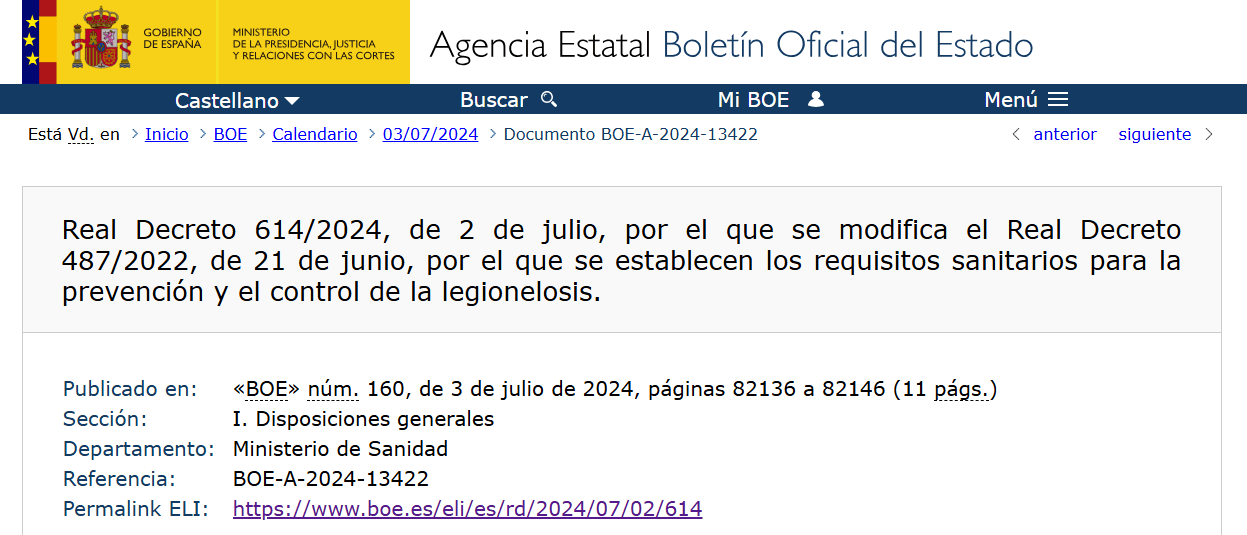
Conclusion, Royal Decree 614/2024 on 2024 Legionella regulations
This Royal Decree 614/2024 2024 Legionella regulations modifies Royal Decree 487/2022, of June 21, which establishes the health requirements for the prevention and control of legionellosis.
Improving the previous regulations with a more balanced approach adapted to different types of installations.
It reinforces shared responsibility, ensures technical competence in sampling, and provides flexibility to some requirements that were previously rigid or difficult to comply with in certain circumstances.
This contributes to better prevention and control of Legionella, without creating an administrative or technical overload for operators and facility managers
Summary Table Royal Decree 614/2024
| Key Points | Description |
|---|---|
| Operator’s responsibility | The responsibility is extended to the facility operator, in addition to the owner. This distributes responsibility among all actors involved in facility management. |
| Accreditation for sampling | Companies responsible for sampling must be accredited under the UNE-EN-ISO/IEC 17025:2017 standard by 2030. |
| Modifications to sampling programs | Sampling requirements are made more flexible in collective use facilities (hotels, hospitals), allowing plans to be adapted to the specific characteristics of each facility. |
| Temperature and accessibility in accumulators | Water accumulators must maintain a minimum temperature of 60 ºC (DHW) and 70 ºC (inter-accumulators). Additionally, a 400 mm inspection opening is required to facilitate cleaning and maintenance of tanks larger than 750 liters. |
| Adaptation deadlines | Facilities must update their Legionella Prevention and Control Plans (PPCL) by July 2025. |
| Lower risk installations | Control protocols are simplified for lower-risk installations, such as ornamental fountains and irrigation sprinklers, without compromising health safety. |
| Penalty system | Sanctions for non-compliance with health regulations are maintained, aligned with Law 40/2015. Companies and operators that do not comply with regulations may be penalized. |