
Termites, Pest Control
PEST CONTROL EXPERTS
Termite Control
At Gimasur, we have the best specialists in termite control. Exterminating this type of insect is not an easy task without the help of a professional; home remedies only help with their expansion and propagation.
Our termite experts offer our clients quick, safe, and effective solutions through various prevention and control treatments, either through our Sentritech bait system or chemical injection treatment, depending on the magnitude of the problem.
EXTERMINATING THIS TYPE OF PEST IS IMPOSSIBLE WITHOUT THE HELP OF A PROFESSIONAL TERMITE SPECIALIST
If there is an infestation of this type of insect in your business, home, or property, contact us immediately through the following form, and we will provide you with a quote tailored to your needs without any obligation.
958 07 44 44
Problems with termites? We’ll solve them for you!
Termites primarily feed on wood (doors, beams, furniture, windows…) and cellulose (textiles, cardboard, paper…). In Andalusia, all affected structures and constructions belong to the Reticulitermes sp. species, better known as subterranean termites since they move and access homes through the ground or walls.
Therefore, the first signs of attack appear in the lower parts of doors located in basements and ground floors of homes, mainly in bathrooms, kitchens, and doors leading to gardens or patios.
Termites, or as they are popularly known, white ants, are social insects that live in underground colonies and feed mainly on wood cellulose.
Types of termites:
Within a termite colony, the following castes are distinguished:
Workers:
Generally, small “white ants” are observed in large numbers; these are the workers. They are solely responsible for the damage. They consume and digest cellulose, which they can later regurgitate to distribute to other members of the colony; this process is called trophallaxis. They are constantly searching for food, without rest periods, and moving in all directions in a random search. They are also the ones that build the mud tubes.
Soldiers:
They are less numerous, white, and have a hypertrophied head with 2 large mandibles. They are in charge of protecting the population against enemies (mainly ants). Their hypertrophied head does not allow them to feed themselves, and the workers feed them through trophallaxis.
Neotenics or secondary reproductives:
They are longer than workers (5-6 mm) and have two small wing buds on their back. They can move through the galleries created by the workers, and if the colony divides, they can form a new colony.
The reproducing pair
At the origin of a termite population, there is a pair of reproducers. It consists of a dark-colored king, capable of moving and still retaining his wings, and a wingless queen, also dark but with an abdomen of various brown colors. This abdomen is hypertrophied (from a few millimeters to several centimeters) and houses a reproductive system capable of producing several thousand eggs per year.
The queen is unable to move and, therefore, to feed herself. Like the rest of the population, she is fed by the workers .
The swarming
A visible and often spectacular manifestation of their presence, swarming usually occurs once a year (from January to May, depending on the species and area) when populations are already well established.
At this time, hundreds of primary reproductives fly out through holes created by the workers. These reproductives are winged and dark in color. Their flight is very short. By chance, pairs are formed, and the luckiest ones, which find a cavity in the wood to nest, will be able to reproduce and create a new population.
With the exception of winged reproductives, all other termite castes are apterous, meaning they lack wings. They move and communicate thanks to specific substances they leave behind that their fellow termites recognize. These are trail pheromones. There are also alarm pheromones, secreted in case of danger and intended to alert the rest of the population.
Therefore, termites are social insects that communicate: they not only exchange food but also information that indicates both the path to follow to find food and alert to the presence of danger.
Development of termites
Like most invertebrates, termites grow in stages. At the end of a growth period, when the external skeleton (cuticle) becomes too small, it gradually sheds and a new larger shell forms immediately. This process is called molting. Termites molt approximately ten times before reaching their final size.
How to detect termites and damage they cause
Wood attacked by termites generally does not show visible symptoms on the exterior as they always leave a small film that remains intact. Meanwhile, the interior of the wood is consumed in thin layers along the direction of the fibers, and no sawdust residue is seen from the outside. In case they penetrate the external film (surface wood, wallpaper, paint,…), they quickly cover the hole with a mixture of soil, saliva, and excretions.
Thus we see nothing more than a small dark spot sometimes the size of a pinhead. Generally, termites attack all cellulosic materials, mainly wood. They devour furniture attached to the wall, door frames, baseboards, carpentry in general, and double walls, but also cardboard and books.
The termites move through structures and consume wood, for which, if necessary, they penetrate soft materials such as plaster or polystyrene. They also use cracks in concrete or joints between stones or bricks to make their way. In cases where they cannot penetrate them, they build small dark brown tunnels inside which they move towards their target. These cords are constructed with small particles, a mixture of saliva, soil, and excretions. It is not uncommon for these constructions to appear as ‘stalactites’ or ‘stalagmites’.
The diagnosis is sometimes difficult and requires the technical knowledge of a professional, accompanied by the Termatrac, a motion, moisture, and temperature radar. At Gimasur, we perform two types of termite prevention and control treatments. The Sentritech bait system and the chemical injection treatment. One system or the other will be advised depending on the type of attack, as well as the characteristics of the house.

Termite elimination treatment: SENTRITECH System
The Sentritech system is the most effective and innovative system on the market to tackle the problem of termites. Its operating principle is based on the diffusion of an insecticide product to all individuals in the colony: hexaflumuron.
This insecticide used has a delayed effect, distributed in bait form or food, containing a special formulation that will be consumed by worker termites. Little by little, through the phenomenon of trophallaxis (food exchange), it will cause the entire colony to be intoxicated and die.
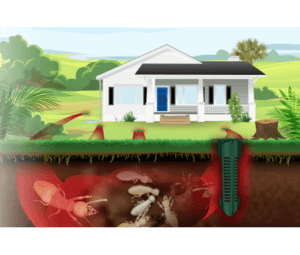
The product used is an insect growth regulator: hexaflumuron, which inhibits the synthesis of chitin, the main component of the insect exoskeleton. Thus, when the termite molts, the new cuticle does not form and, without this protective skin that serves as its skeleton, the insect cannot live.
NOT TOXIC: The product is specific to insects and has no effect on humans (neither adults nor children) nor on domestic animals or other vertebrates. In this way, the product has a relatively slow action, which allows enough time to spread the insecticide within the entire colony.
NO EFFECT ON THE ENVIRONMENT: The amounts of insecticide product used are very small and are only placed in areas where there is clearly an infestation. We have available, and it is at the disposal of interested parties, the authorization SENTRIBOX HD REG. 17-30-08895, SENTRISOL HD REG. 16-30-08351, CTBP Certificate, Safety Data Sheets, and a doctoral thesis titled ‘Study on the use of Hexaflumuron for the control of subterranean termites’ which demonstrates the 100% effectiveness of the Sentritech System.
The Sentritech methodology consists of three stages:
Stage 1: INSPECTION – INSTALLATION
- Detailed inspection of the property and installation of SENTRIBOX stations in affected wooden structures and SENTRISOL stations in the ground.
Stage 2: CONTROL
- Periodic visits, approximately every 3 months, for the extermination of the colony through SENTRITECH stations. Both the system stations and the ‘area to be protected’ will be reviewed.
Stage 3: MAINTENANCE
- Once the previous stage is completed, visits will be made during the times of maximum risk, which will coincide with the periods of maximum termite activity. Twice a year in the 2nd year, and once a year in the 3rd-4th and 5th years.
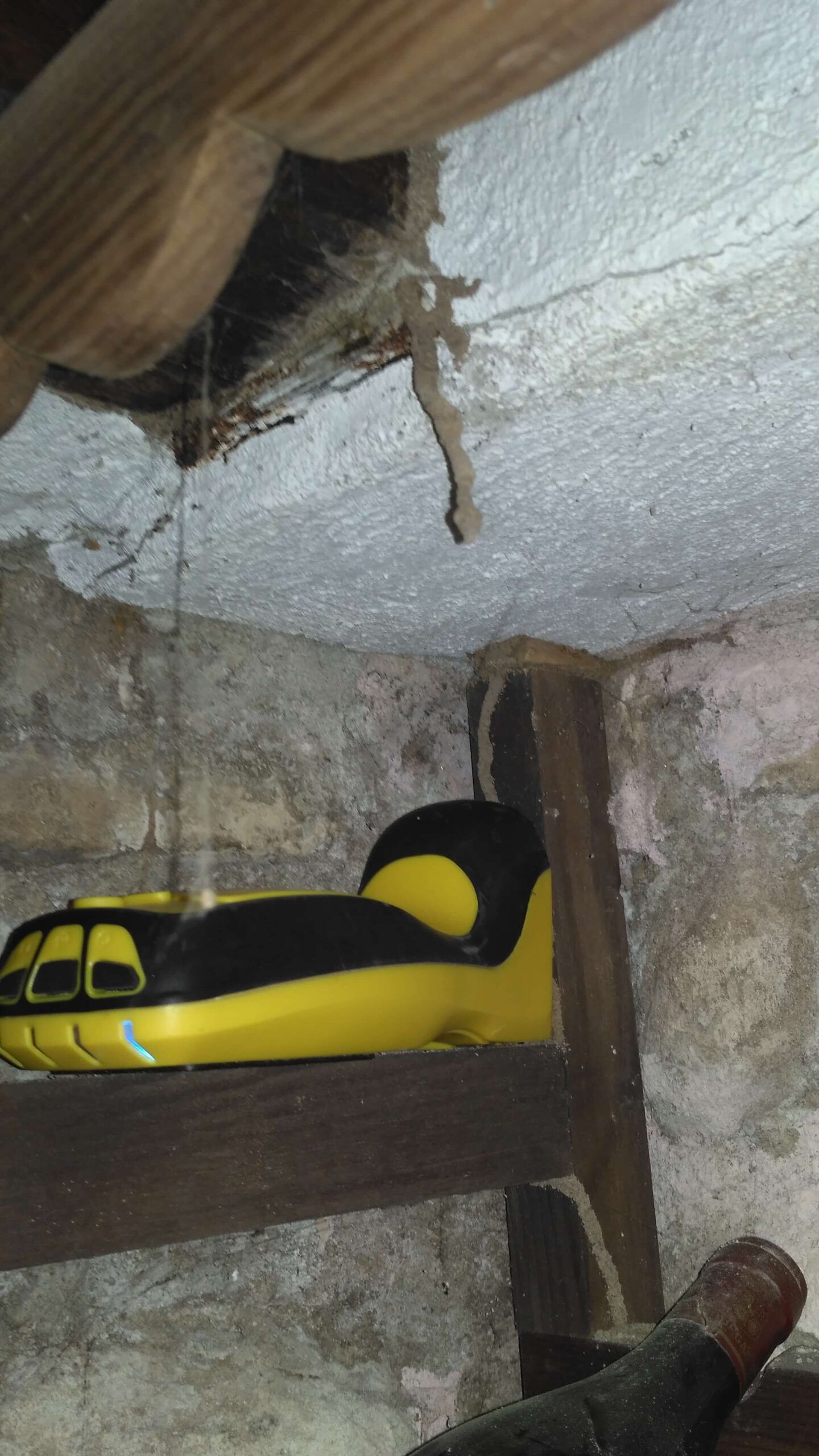
Stage 1: Inspection – Installation
Objective: To locate termite attack and risk points and make contact with the colony in order to allow future intoxication. Means: Use easy-to-control and review work stations along with a Termatrac radar detector.
Procedure:
- Preparation of an action plan.
- Identification of noticeable damage and potential termite risk areas, at least in their visible part. This inspection will be complemented with the use of an acoustic or moisture detector.
- Inside wooden structures, SENTRIBOX HD stations will be placed at specific points of termite attack or activity, if possible.
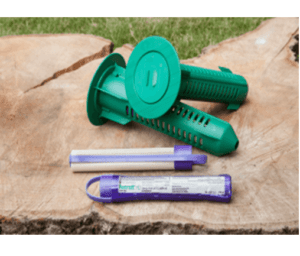
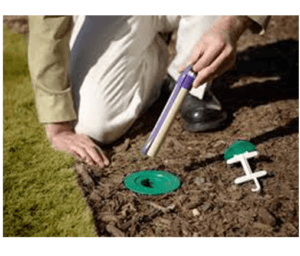
In this case, we will place stations in all the attacked door frames in the small construction, as well as in the different points where we can find activity at the time of installation. On the exterior and interior, SENTRISOL HD stations will be placed in the ground and flooring area, creating a perimeter fence around the construction.
- Regular checks of the installed stations, as well as detailed periodic inspections of the entire ‘area to be protected’.
The stations are placed according to specific technical recommendations and taking into account the social and biological behavior of termites. Depending on the type of construction and the nature of termite activity, two types of stations can be used: SENTRISOL HD: placed in the ground, generally on the exterior and appropriately distributed. SENTRIBOX HD: generally placed on the interior and installed directly on termite trails. Detecting all termite activities in a structure is an essential step to obtain good results from the SENTRITECH system. An electronic acoustic termite detector, TERMATRAC, is available for use on wood.
Stage 2: Control
Objective: To spread the insecticide product within the colony using the worker termites.
Means: Distribution of the product through baits placed at the disposal of termites at points where they are active. When a termite attack is detected, the cellulose impregnated with Hexaflumuron enters the termites’ food chain. To increase consumption, Self Recruitment is used, which consists of collecting the detected termites and relocating them to the new baits. Once they pass through the bait with insecticide and return to the colony, these individuals easily communicate the location of the bait to the rest of the colony using trail pheromones.
Procedure:
- In all SENTRITECH stations where activity is detected, insecticide baits (laminated and textured cellulose impregnated with hexaflumuron) will be placed, which will be replaced with new ones as they are consumed by the termites.
- SENTRITECH stations will be periodically controlled at intervals that will vary according to the activity developed by the termite colonies, but if consumption is high, every 3 months.
- Detailed inspections of the ‘area to be protected’ will also be carried out during this phase.
- During this phase, the number and placement of SENTRITECH stations will be adapted to the control strategy and termite behavior.
- This set of actions will be maintained until complete control of the termite colonies affecting the “area to be protected” is achieved. The SENTRITECH methodology will be constantly adapted based on the characteristics of the termite colony (estimated size, range of action, activity level…) and the particularities of the construction.
Stage 3: Maintenance
Objective: Ensure maintenance of the treated area.
Means: Periodically control stations with inert elements and “Sensitive” areas prone to the development of subterranean termites. When the control phase ends, maintenance is the guarantee that regular long-term monitoring will be carried out throughout the protected area. The exterior work stations remain in the same place where they were installed; their inspection and a control of the structure are carried out at least twice a year. Thus, any possible infestation by a new colony of a building will be quickly detected before it becomes established in the structure. If necessary, rapid intoxication action is carried out.
Procedure: Periodic controls of SENTRITECH stations along with detailed inspections of the “area to be protected”. These controls will be carried out twice a year in the 2nd year, and once a year in the 3rd, 4th, and 5th years in order to guarantee protection in the considered area until completing the fifth year of treatment.
Experts in exterminating any pest
100% effectiveness guarantee of the Sentritech system
After signing the contract, the client will be given a written guarantee certificate, signed and sealed by Gimasur Ambiental, S.L. (authorized applicator), Sanitrade (National Distributor), and Cortega (Global Manufacturer).
Contact us for Termite control!
At Gimasur, we are here to help you control and eliminate termites in your business.
Get in touch with us and tell us everything through our phone number: 958074444 throughout Andalusia.
Request a quote with no obligation